
Keratoconus: Treatment Options in Korea
What is keratoconus?
Keratoconus is a condition in which the cornea, the clear dome at the front of the eye, thins and gradually bulges into a cone shape. The American Academy of Ophthalmology (AAO) explains that this distorts how light focuses, causing blurred and distorted vision that can make reading and driving difficult.
The cause is unknown. The AAO notes that about 1 in 10 people with keratoconus has a parent with it, and that it is linked to eye allergies, heavy eye rubbing and connective tissue disorders such as Marfan and Ehlers-Danlos syndromes. It usually starts in the late teens or early 20s, often affects both eyes unequally, and can worsen over 10–20 years.
What are the symptoms?
Early keratoconus can look like ordinary short sight or astigmatism. Warning signs are mild blur, straight lines that look bent or wavy, glare and light sensitivity, and a prescription that keeps changing.
Later, nearsightedness and astigmatism increase, glasses help less, and soft contact lenses become hard to wear. In some people the cornea swells suddenly and scars. If your astigmatism has risen year after year, ask for corneal topography rather than just a new prescription.
How is keratoconus diagnosed?
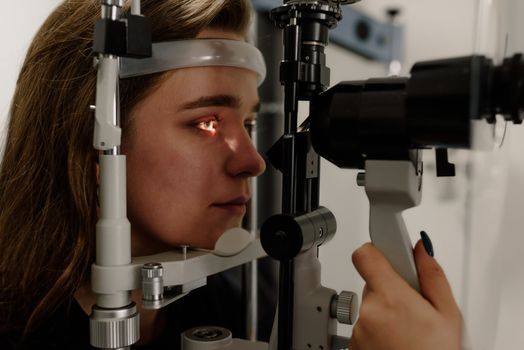
It is diagnosed in an eye exam that maps the cornea. The AAO describes corneal topography, a computer map of the corneal surface, alongside measurement of corneal curvature. Corneal tomography devices such as the Pentacam also map the back surface and thickness, which helps find early or subclinical disease.
This is exactly why Seoul refractive clinics scan every cornea before laser surgery. The AAO's EyeWiki lists keratoconus and "forme fruste" (subclinical) keratoconus among the highest risk factors for ectasia after LASIK. Many people first learn they have keratoconus at a LASIK consultation. See the pre-op eye exam guide.
Which treatments in Seoul address keratoconus?
Treatment has two goals: stop the cornea getting worse, and give you the best possible vision with what remains. The stage of disease decides the mix.
| Situation | Usually considered | Notes |
|---|---|---|
| Mild, stable | Glasses or soft toric contact lenses; regular scans | Monitor for progression |
| Progressing on repeated scans | Corneal cross-linking (CXL) | About $1,100–$2,000 per eye (≈₩1.5M–₩2.8M) |
| Moderate, poor vision in glasses | Rigid gas-permeable or scleral lenses; corneal ring segments (Intacs) | Quoted individually |
| Stable, needs refractive correction | Phakic lens such as a toric ICL, case by case | Only if a surgeon judges the cornea stable |
| Advanced or scarred | Corneal transplant | University hospital care |
| Any stage | Standard LASIK | Not suitable |
How does corneal cross-linking work?
Cross-linking strengthens the cornea by creating new bonds between its collagen fibres. The AAO describes it as using ultraviolet light and eye drops to stiffen the cornea. The surgeon soaks the cornea in riboflavin (vitamin B2) and then exposes it to UV-A light.
The aim is to stop or slow progression, not to reverse it, so you will usually still need glasses or contact lenses afterwards. In the standard "epi-off" method the surface layer is removed first, which means several days of discomfort and blurred vision. Treating early, while vision is still good, gives the best chance of keeping it. Read the cross-linking guide for the procedure day and recovery.
What does keratoconus treatment cost in Seoul?
International medical-travel listings for Korea show cross-linking at approximately $1,100–$2,000 per eye (about ₩1.5M–₩2.8M), checked in 2026; several hospitals quote only after an exam. For comparison, UCLA Health lists $4,600 per eye in the U.S. A toric ICL, where suitable, costs about ₩5M–₩7.5M for both eyes. See the cross-linking cost guide and eye exam cost.
Can I have laser eye surgery if I have keratoconus?
Not standard LASIK. The AAO lists keratoconus among the conditions for which LASIK should not be done, because removing tissue can weaken an already unstable cornea and speed up the bulging. Some specialists combine limited surface treatment with cross-linking in carefully selected eyes, but this is a specialist decision, not a routine vision-correction package. Our guides to corneal thickness and LASIK candidacy explain why clinics turn people down.
How should I plan keratoconus care abroad?
Bring every previous corneal scan you have. Progression is shown by comparing scans taken months apart, and without them a clinic may need to scan you twice before advising cross-linking. Plan about a week in Seoul for epi-off CXL and line up an eye doctor at home for the months of follow-up scans; see follow-up care after returning home.
Day to day, the AAO advises not rubbing your eyes and getting allergies treated. This page is general information; keratoconus needs ongoing care from an ophthalmologist.
What should I ask a Seoul clinic about keratoconus?
- Is my keratoconus progressing, and how do you measure that?
- Which cross-linking protocol do you use (epi-off, epi-on or accelerated), and why?
- What is my thinnest corneal reading, and does it allow standard treatment?
- Who will monitor my scans after I go home, and how often?
- If my vision in glasses is poor, which specialty lenses do you recommend?
If a clinic offers you a standard LASIK package despite keratoconus findings on your scans, treat that as a warning sign and get a second opinion from a corneal specialist, ideally at a university hospital.
Sources
Key facts
- What it is: the cornea thins and bulges into a cone, distorting vision
- Typical onset: late teens or early 20s, worsening over 10–20 years (AAO)
- Main treatment to halt it: corneal cross-linking, about $1,100–$2,000 per eye in Korea
- Not suitable: standard LASIK on a keratoconic cornea
- Detail: keratoconus treatment in Korea
Related guides
General information, not medical advice. Only a full eye exam by a licensed ophthalmologist can confirm your diagnosis and which treatment is safe for you.
FAQ
Frequently asked questions
Can keratoconus be cured?
No, but it can usually be stabilised. Cross-linking aims to stop progression, and lenses or surgery can improve vision in the cornea you have.
How much is corneal cross-linking in Korea?
Medical-travel listings show approximately $1,100–$2,000 per eye (about ₩1.5M–₩2.8M) in 2026. Get a written per-eye quote after an exam.
Can I get LASIK with keratoconus?
No. The AAO lists keratoconus as a reason not to have LASIK, because it can make the cornea weaker. Ask about cross-linking and lens-based options instead.
Is ICL possible with keratoconus?
Sometimes, once the cornea is shown to be stable, often after cross-linking. It is a case-by-case decision for a corneal specialist.
Does eye rubbing cause keratoconus?
Heavy eye rubbing is linked to keratoconus and can worsen it. The AAO advises avoiding eye rubbing and treating eye allergies.
Planning vision correction in Seoul?
Compare clinics by district, check 2026 price ranges, and read our step-by-step planning guide for international patients.