
SMILE Pro in Korea: VisuMax 800, Cost & How It Differs from SMILE
What is SMILE Pro?
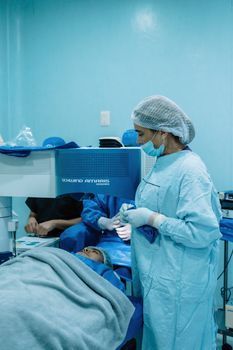
SMILE Pro is the latest version of SMILE (Small Incision Lenticule Extraction) keyhole laser eye surgery, performed on the ZEISS VisuMax 800 femtosecond laser. The surgical principle is the same as classic SMILE; the laser and software are newer and faster.
In both versions, a femtosecond laser shapes a thin disc of tissue (a lenticule) inside the cornea, and the surgeon removes it through a small incision of roughly 2–3 mm. This changes the curvature of the cornea and corrects nearsightedness, with or without astigmatism. Unlike LASIK, no corneal flap is cut. The U.S. FDA approved the VisuMax 800 with SMILE pro software in January 2024.
How does SMILE Pro differ from classic SMILE?
The main difference is speed: the VisuMax 800 creates the lenticule in under 10 seconds per eye, according to ZEISS, using a 2 MHz pulse rate. Earlier VisuMax lasers take noticeably longer, so you spend less time under suction.
The VisuMax 800 also adds CentraLign, a computer-guided centration aid, and OcuLign, which adjusts for cyclotorsion (slight rotation of the eye when you lie down), most useful when astigmatism is corrected. The lenticule, incision and healing do not change. Read our SMILE vs SMILE Pro comparison for more.
| Feature | Classic SMILE | SMILE Pro |
|---|---|---|
| Laser platform | Earlier ZEISS VisuMax | ZEISS VisuMax 800 |
| Laser time per eye | Longer | Under 10 seconds |
| Centration and rotation aids | Surgeon-guided | CentraLign and OcuLign |
| Flap | None, small incision | None, small incision |
| Typical Seoul price (both eyes, 2026) | ₩2.2M–₩3.2M | About ₩3M–₩5M (typically around ₩4M) |
A shorter laser time matters most to anxious patients and to people who find it hard to keep still. It does not change how much tissue is removed, so the visual result depends mainly on your eye, the planning and the surgeon.
How much does SMILE Pro cost in Korea?
In 2026, Seoul clinics quote SMILE Pro at about ₩3M–₩5M for both eyes, typically around ₩4M (approximately $2,200–$3,700).
SMILE Pro usually costs about ₩0.8M–₩1.8M more than classic SMILE (₩2.2M–₩3.2M) at the same clinic. Some advertised prices are per eye, so always ask, and check what the quote includes. See our SMILE Pro cost guide and SMILE cost in Korea vs the USA.
Who is a good candidate for SMILE Pro?
Good candidates are adults with stable nearsightedness, with or without astigmatism, and healthy corneas. Candidacy is the same as for classic SMILE.
- Age 18 or older, with a stable prescription for at least a year
- Enough corneal thickness after the planned correction
- No signs of keratoconus or other corneal thinning
- No uncontrolled dry eye
SMILE Pro does not treat farsightedness in most clinics. If your cornea is thin or your prescription very high, a lens implant may suit you better; see ICL vs SMILE. Only a full exam can tell; our pre-op eye exam guide explains what is measured.
How long is SMILE Pro recovery?
Most people see well enough for daily tasks within 24–48 hours, and vision keeps sharpening over several weeks. The procedure itself takes about 10–15 minutes for both eyes under numbing drops.
Expect light sensitivity, grittiness and some blur on day one. Most Korean clinics check you the next day and again within a week. Use drops as prescribed and avoid rubbing your eyes. Screen work is usually possible within a few days, but your eyes may tire quickly at first. See our SMILE recovery timeline and flying after eye surgery.
What are the risks of SMILE Pro?
SMILE Pro carries the same risks as classic SMILE; a faster laser does not remove them. Most side effects are temporary, but some can last.
- Dry eye for weeks to months; see dry eye after laser eye surgery
- Glare, halos or starbursts at night
- Under- or over-correction that may need a further procedure
- Rare problems with lenticule removal, infection or inflammation
- Very rarely, corneal weakening (ectasia)
If a touch-up is ever needed, it is usually done as a surface treatment (PRK) rather than a repeat SMILE, so ask how a clinic handles enhancements. Results cannot be guaranteed. Discuss your personal risk with an ophthalmologist after a full exam, and read laser eye surgery side effects.
Is SMILE Pro better than LASIK?
Neither is better for everyone. SMILE Pro avoids a flap and may cause less early dry eye, while LASIK treats a wider range of prescriptions, including farsightedness, and allows simpler touch-ups.
People in contact sports or jobs with a risk of eye injury often prefer a flapless procedure. People with farsightedness or who want the most flexible enhancement options may lean towards LASIK. Compare them in SMILE vs LASIK in Korea, or browse top SMILE clinics in Seoul.
How should you plan a SMILE Pro trip to Seoul?
Book the pre-op exam before your flights where possible, and allow 3–5 days in Seoul. Most clinics do the exam and surgery on the same or consecutive days, then check you the next morning.
- Ask how long to stop wearing contact lenses before the exam; soft and rigid lenses have different rules
- Send recent prescriptions and any previous eye records in advance
- Check whether you need a K-ETA or visa before you travel
- Stay near the clinic so the next-day visit is easy
- Bring sunglasses and avoid booking a flight home on the day of surgery
Questions worth asking every clinic: which laser they use, how many SMILE Pro procedures the surgeon has done, what the price includes, whether it is per eye or both eyes, and what happens if you need a touch-up after you return home.
Sources
- Ophthalmology Times – FDA approves the VisuMax 800 with SMILE pro software
- OphthalmologyWeb – FDA Approves the VISUMAX 800 with SMILE pro software
- isclinic – 2026 LASIK, LASEK and SMILE costs (Korean)
- Glasswallet – Vision correction cost calculator (Korean)
- BGN Eye Clinic – SMILE Pro prices: what to expect
Key facts
- Laser: ZEISS VisuMax 800 femtosecond laser with SMILE pro software (2 MHz pulse rate)
- Laser time: Under 10 seconds per eye to create the lenticule
- Price in Seoul (2026): About ₩3M–₩5M for both eyes, typically around ₩4M; see the SMILE Pro cost guide
- Corrects: Nearsightedness (myopia) with or without astigmatism
- Stay in Seoul: Usually 3–5 days including exam and next-day check
Related guides
Independent directory. Prices are typical ranges reported by Seoul clinics and change often. Always confirm a written quote and get a full eye exam before booking. This page is general information, not medical advice.
FAQ
Frequently asked questions
Is SMILE Pro the same as SMILE?
Yes, in principle. SMILE Pro is SMILE performed on the newer ZEISS VisuMax 800 laser, which creates the lenticule in under 10 seconds per eye. The tissue removed, the incision and the healing are essentially the same.
How much is SMILE Pro in Seoul?
In 2026 most Seoul clinics quote about ₩3M–₩5M for both eyes, typically around ₩4M (approximately $2,200–$3,700). Confirm whether a price is per eye or both eyes and what follow-up care it includes.
Is SMILE Pro worth the extra cost over SMILE?
The main benefits are a shorter laser time and centration and rotation aids. Visual results are expected to be similar, so many patients choose based on the surgeon and clinic rather than the laser version.
How many days do I need in Korea for SMILE Pro?
Plan on 3–5 days: an exam, surgery and a next-day check. Ask your surgeon before booking flights.
Can SMILE Pro fix astigmatism?
Yes, SMILE Pro treats nearsightedness with or without astigmatism. The OcuLign feature helps adjust for eye rotation during astigmatism correction. Your exam decides whether your astigmatism is within range.
Planning vision correction in Seoul?
Compare clinics by district, check 2026 price ranges, and read our step-by-step planning guide for international patients.