
SMILE vs SMILE Pro: What's the Difference in Korea?
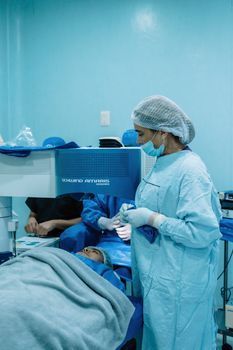
Is SMILE Pro a different surgery from SMILE?
No. SMILE Pro is the same lenticule-extraction technique as SMILE, done on a newer, faster ZEISS femtosecond laser. The surgeon still creates a thin disc of tissue (the lenticule) inside the cornea and removes it through a small incision, without cutting a LASIK-style flap.
Classic SMILE runs on the VisuMax 500; "SMILE pro" is ZEISS's name for the procedure on the VISUMAX 800 with SMILE pro software. New to the technique? Start with our SMILE LASIK surgery in Korea guide.
What actually changes with the VisuMax 800?
The main change is speed: the laser pulse rate rises from 500 kHz to 2 MHz, so the lenticule is cut in under 10 seconds instead of about 30 seconds.
ZEISS also added centration and alignment aids. CentraLign helps the surgeon centre the treatment using the pupil centre and the corneal vertex, and OcuLign uses an iris image from a diagnostic device to suggest a correction for eye rotation (cyclotorsion), which matters most for astigmatism. ZEISS notes that total procedure time still depends on preparation, docking and workflow; one surgeon series reported at a ZEISS-sponsored symposium put total case time at about 7 minutes versus about 9.5 minutes on the older laser.
| Factor | SMILE (VisuMax 500) | SMILE Pro (VisuMax 800) |
|---|---|---|
| Technique | Flapless lenticule extraction | Flapless lenticule extraction |
| Laser pulse rate | 500 kHz | 2 MHz |
| Lenticule cut time | About 30 seconds | Under 10 seconds (manufacturer data) |
| Centration aids | Manual centration | CentraLign and OcuLign assistance |
| Dry eye profile | Generally lower than LASIK | Same principle; no separate long-term data yet |
| US FDA status | Approved for myopia and astigmatism | VISUMAX 800 with SMILE pro approved (announced January 2024) |
| Price in Seoul (both eyes) | ₩2.2M–₩3.2M (≈$1,600–$2,400) | About ₩3M–₩5M, typically around ₩4M (≈$2,200–$3,700) |
Does SMILE Pro give better vision than SMILE?
Not on current evidence. Early surgeon reports describe no difference in uncorrected visual acuity between the two lasers, and there are no large independent head-to-head trials yet.
What the faster laser may improve is the experience. The eye is held under gentle suction while the laser works, and a shorter cut means less time for the eye to move or for suction to break. Surgeons have projected lower suction-loss rates with sub-10-second cuts, but that is a projection, not a measured result. Both share the benefits of flapless surgery over LASIK, including better-preserved corneal sensation and fewer early dry eye symptoms, according to a 2016 meta-analysis of SMILE vs femtosecond LASIK.
How much more does SMILE Pro cost in Korea?
Expect to pay roughly ₩0.8M–₩1.8M more for SMILE Pro than for classic SMILE for both eyes in Seoul.
Classic SMILE costs about ₩2.2M–₩3.2M (approximately $1,600–$2,400) for both eyes. SMILE Pro costs about ₩3M–₩5M for both eyes, typically around ₩4M (approximately $2,200–$3,700), with promotions sometimes lower. Prices were checked in 2026. Confirm whether a quote covers both eyes and includes the exam, medication and follow-ups. See SMILE Pro cost in Korea and SMILE cost in Korea.
Is recovery any different?
Recovery is essentially the same. Most patients see well enough for daily tasks within a day or two, with vision continuing to sharpen over the following weeks.
Because both are flapless, there is no flap to protect, and many patients return to desk work within a couple of days. Light sensitivity and fluctuating vision in the first week are common with either laser. Read the SMILE recovery timeline for a day-by-day picture.
Which prescriptions can SMILE and SMILE Pro treat?
Both treat nearsightedness with or without astigmatism; what is approved beyond that depends on the country and software version.
The FDA approval announced in January 2024 covers the VISUMAX 800 with SMILE pro software for nearsightedness with or without astigmatism. ZEISS states that SMILE pro can be indicated for myopia, hyperopia and astigmatism depending on local approval, and that features and indications vary by market and system configuration. In practice, your upper limit is set less by the laser than by your own cornea: how thick it is and how much tissue the correction would remove. If you are farsighted, ask the clinic directly whether lenticule extraction for hyperopia is approved and offered on their system, rather than assuming it is. See corneal thickness for LASIK for how those limits are calculated.
Who should choose which?
Choose by your eyes and budget first, and by the laser second. An experienced surgeon matters more than the machine.
- Choose classic SMILE if you want the proven flapless technique at a lower price and your clinic has an experienced SMILE surgeon on the VisuMax 500.
- Choose SMILE Pro if you are anxious about suction or keeping still, have astigmatism where rotational alignment matters, or prefer the newest platform and accept the higher cost.
- Consider other options if your cornea is too thin or your prescription is outside lenticule-extraction limits. ICL or LASEK may then be suggested.
How do I check which laser a clinic really uses?
Ask the clinic which ZEISS laser and software version will be used on your eyes, and who the operating surgeon is.
Our list of top SMILE LASIK clinics in Seoul and the Gangnam LASIK clinic listings are a starting point.
What should I ask before booking SMILE Pro?
A few direct questions protect you from paying a SMILE Pro price for a different procedure or an incomplete package.
- Is my quote specifically for SMILE Pro on the VISUMAX 800, and for both eyes?
- Does the price include the pre-op exam, medication, follow-up visits and any enhancement?
- How many lenticule-extraction procedures does my surgeon perform, and on which laser?
- Based on my scans, would classic SMILE give me the same expected result at a lower cost?
- If I have astigmatism, will cyclotorsion alignment (OcuLign) be used for my treatment?
- How many days should I stay in Seoul before flying home?
Bring the full list from questions to ask your LASIK surgeon. A full pre-op exam and an ophthalmologist's advice decide whether either procedure is safe for you; no laser can guarantee a specific outcome.
Sources
- ZEISS – VISUMAX 800 product page
- Ophthalmology Times – FDA approves the VisuMax 800 with SMILE pro software
- CRST (ZEISS-sponsored supplement) – VISUMAX 800: speed and comfort
- PubMed – Meta-analysis of SMILE vs FS-LASIK for myopia (2016)
- Modoodoc – Ophthalmologist answers on SMILE and SMILE Pro prices (Korean)
Key facts
- Procedure: Both are keratorefractive lenticule extraction (KLEx) through a 2–4 mm incision, no flap
- Laser: SMILE on ZEISS VisuMax 500 (500 kHz); SMILE Pro on VisuMax 800 (2 MHz)
- Lenticule cut time: about 30 seconds vs under 10 seconds
- Price in Seoul (both eyes): SMILE ₩2.2M–₩3.2M; SMILE Pro about ₩3M–₩5M (typically around ₩4M)
- Results: early reports show no clear difference in uncorrected vision
- More detail: SMILE Pro in Korea
Related guides
Independent directory. Prices are typical ranges reported by Seoul clinics and change often. Always confirm a written quote and get a full eye exam before booking. This page is general information, not medical advice.
FAQ
Frequently asked questions
Is SMILE Pro worth the extra cost?
It depends on what you value. Visual outcomes appear similar to classic SMILE, so the extra ₩0.8M–₩1.8M mainly buys a shorter laser time and newer alignment aids. If budget matters, classic SMILE with an experienced surgeon is a sound choice.
Does SMILE Pro really take 10 seconds?
Only the laser cut takes under 10 seconds per eye. Preparation, docking and lenticule removal add several minutes, so expect around 10–15 minutes in the operating room for both eyes.
Is SMILE Pro FDA approved?
Yes. ZEISS announced in January 2024 that the FDA approved the VISUMAX 800 with SMILE pro software for nearsightedness with or without astigmatism. Indications in Korea and other countries depend on local approval.
Is SMILE Pro better for astigmatism?
It may help alignment, because OcuLign can suggest a correction for eye rotation and CentraLign assists centration. Classic SMILE also treats astigmatism; your surgeon will advise based on the amount and axis.
Can I get SMILE Pro if I have thin corneas?
Not always. SMILE Pro removes tissue just like SMILE, so corneal thickness and shape still limit candidacy. Your pre-op exam decides.
Planning vision correction in Seoul?
Compare clinics by district, check 2026 price ranges, and read our step-by-step planning guide for international patients.