
Astigmatism: Treatment Options in Korea
What is astigmatism?
Astigmatism is an imperfection in the curve of the cornea or the lens inside the eye. The American Academy of Ophthalmology (AAO) describes the eye as shaped more like a football than a basketball, so light does not focus to a single sharp point and both near and far vision look blurred or distorted.
It is very common, usually inherited, and often occurs together with nearsightedness or farsightedness. It can also follow eye disease, injury or surgery. Symptoms include blur, distorted areas of vision, squinting, headaches and eye discomfort.
Regular or irregular: why does the type matter?
Regular astigmatism has a symmetrical, predictable shape and is what glasses, laser surgery and toric lenses correct well. Irregular astigmatism has an uneven pattern, often caused by keratoconus, scarring or previous surgery, and needs a different approach.
This distinction is the most important thing your exam will establish. Irregular astigmatism caused by keratoconus is a reason not to have LASIK, because removing tissue can weaken an already unstable cornea. If your scans suggest it, read our keratoconus guide.
How is astigmatism diagnosed?
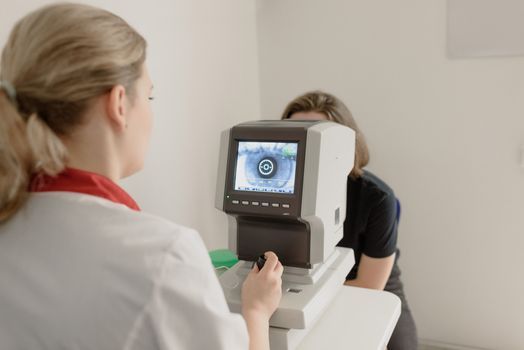
An ophthalmologist diagnoses astigmatism during a comprehensive eye exam. The AAO lists the tools: an eye chart for acuity, a phoropter and autorefractor for the prescription, and a keratometer or corneal topography to measure the corneal curve and surface irregularities.
Before surgery, Seoul clinics add corneal tomography (front and back surface maps), corneal thickness, and checks that your astigmatism axis is the same on different devices. For a lens implant they measure the eye's internal dimensions. See the pre-op eye exam guide.
Which treatments in Seoul address astigmatism?
Most regular astigmatism can be corrected at the same time as the main prescription. The choice depends on how much astigmatism you have, your other prescription, your cornea and your age.
| Situation | Usually considered | Seoul price (2026) |
|---|---|---|
| Low to moderate regular astigmatism, healthy cornea | LASIK, LASEK, SMILE | ₩1.5M–₩3.2M both eyes |
| Astigmatism with an uneven corneal surface | Topography-guided LASIK (Contoura) | Quoted individually |
| Higher astigmatism with high myopia or thin cornea | Toric ICL | ≈₩5M–₩7.5M both eyes |
| Astigmatism with cataract or over about 45 | Toric IOL in cataract surgery or RLE | ₩3.5M–₩6.5M per eye |
| Irregular astigmatism from keratoconus | Cross-linking, rigid or specialty lenses | CXL ≈$1,100–$2,000 per eye |
Laser surgery or toric ICL for astigmatism?
For low to moderate astigmatism on a healthy, thick cornea, laser surgery is usually simplest and cheapest. A toric ICL makes more sense when astigmatism comes with high myopia or a cornea too thin to treat safely.
A toric ICL has astigmatism correction built in and must be rotated to your astigmatism axis during surgery; STAAR's earlier U.S. toric approval covered about 1.0–4.0 D of cylinder, though clinics outside the U.S. may use wider ranges. SMILE corrects astigmatism too, but the amount and techniques for aligning the treatment vary by laser and surgeon, so ask. Compare in toric ICL vs LASIK for astigmatism and LASIK with astigmatism.
What does astigmatism correction cost in Seoul?
Astigmatism is usually included in the standard laser price: about ₩1.5M–₩2.5M for LASIK or LASEK and ₩2.2M–₩3.2M for SMILE, both eyes (approximately $1,100–$2,400). A toric ICL costs about ₩1M more than a standard ICL, around ₩5M–₩7.5M for both eyes. Prices were checked in 2026; see the toric ICL cost guide and the LASIK cost guide.
What are the risks of astigmatism surgery?
The risks are those of the procedure chosen. The AAO lists dryness, fluctuating vision, glare, halos and reduced night vision after LASIK, usually improving within weeks but occasionally lasting. With toric lenses, a lens that rotates away from its axis can leave residual astigmatism and may need repositioning. Under-correction of astigmatism is a common reason for an enhancement. Read halos and glare after LASIK.
What about children with astigmatism?
Children are treated with glasses, not surgery. The AAO warns that untreated astigmatism can affect school work and lead to amblyopia, which is why early screening matters.
Whatever you choose, get a full exam first and ask the surgeon to explain your topography maps. This page is general information, not medical advice.
What should I ask about astigmatism correction?
Astigmatism results depend on accurate measurement and alignment, so it is worth asking how a clinic handles both.
- Is my astigmatism regular or irregular, and can you show me the topography map?
- Do my readings agree across devices, and on which axis?
- How much astigmatism will you treat with the laser, and how do you align the treatment?
- If you recommend a toric lens, how do you mark the axis and what happens if it rotates?
- Is an enhancement included if some astigmatism remains?
Bring old prescriptions too: a stable cylinder and axis over several years supports a laser plan, while rising astigmatism should prompt a check for keratoconus.
Finally, ask what happens if your astigmatism is mostly inside the eye rather than on the cornea. Lenticular astigmatism, from the natural lens, can change after lens surgery, and corneal laser treatment may then over- or under-correct. Your surgeon can compare corneal and total astigmatism readings to judge this before choosing a method.
A good clinic will welcome these questions and answer them with your own measurements in front of you.
Sources
Key facts
- What it is: an uneven corneal or lens curve, shaped more like a football than a ball
- Key tests: keratometry and corneal topography
- Laser options: LASIK, LASEK/PRK, SMILE, topography-guided LASIK
- Lens options: toric ICL ≈₩5M–₩7.5M both eyes; toric IOL in lens surgery
- Detail: astigmatism correction in Korea
Related guides
General information, not medical advice. Only a full eye exam by a licensed ophthalmologist can confirm your diagnosis and which treatment is safe for you.
FAQ
Frequently asked questions
Can LASIK fix astigmatism?
Yes. LASIK, LASEK and SMILE correct regular astigmatism at the same time as nearsightedness or farsightedness, within limits your surgeon sets after measuring your cornea.
How much astigmatism is too much for LASIK?
There is no single number; it depends on your whole prescription and corneal thickness. Higher astigmatism, especially with high myopia, is often treated with a toric ICL instead.
Does astigmatism cost extra in Korea?
Usually not for laser surgery. A toric ICL costs about ₩1M more than a standard ICL, and toric IOLs cost more than standard monofocal lenses.
Is irregular astigmatism treatable?
Often yes, but not with standard LASIK. Depending on the cause, options include cross-linking for keratoconus, topography-guided treatment, or rigid and scleral contact lenses.
Can astigmatism come back after surgery?
Some regression or under-correction can occur and may be treated with an enhancement. Astigmatism can also change with age or corneal disease.
Planning vision correction in Seoul?
Compare clinics by district, check 2026 price ranges, and read our step-by-step planning guide for international patients.