
LASIK Enhancement in Korea: Touch-Up Surgery After LASIK
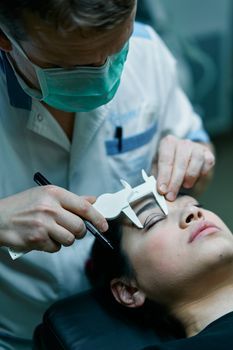
What is a LASIK enhancement?
A LASIK enhancement, or touch-up, is a further laser treatment to fix a prescription that remains or returns after LASIK. It aims to sharpen vision that is close to, but not at, the planned result.
Common reasons are slight under-correction, regression as the eye heals, natural prescription changes over the years, or astigmatism that was not fully treated. Enhancement is not a fix for every problem: blur from dry eye, early cataract or corneal disease needs a different treatment.
Surgeons report that enhancement rates are lower today than in LASIK's early years, thanks to better lasers and planning, but a small share of patients still benefit from a touch-up.
When can you have a LASIK touch-up?
Surgeons usually wait until your prescription has been stable on two measurements taken three to six months apart. Treating too early risks chasing a target that is still moving.
Before deciding, the surgeon repeats a full exam with corneal tomography to rule out early ectasia (corneal weakening) or lens changes. If dry eye is part of the problem, it is treated first; see dry eye after LASIK.
Patients who are many years past LASIK and over about 40 should also expect a check for early lens changes, because a developing cataract can shift the prescription and would not be fixed by more laser treatment.
Flap lift or PRK: which method is used?
The surgeon either lifts the original flap and re-treats underneath, or treats the surface of the flap with PRK. The choice depends on time since surgery, flap and corneal thickness, and the size of the correction.
| Factor | Flap lift | Surface ablation (PRK on flap) |
|---|---|---|
| Visual recovery | Fast, often 1–2 days | Slower, several days to weeks |
| Epithelial ingrowth risk | Higher, especially years after surgery | Very low |
| Haze risk | Low | Higher; mitomycin-C is often used |
| Typical use | Within a few years of LASIK | Many years after LASIK or thin flaps |
One surgeon's data showed epithelial ingrowth in about 1 in 1,440 primary LASIK cases but about 1 in 40 enhancements. Another study found ingrowth of about 1% when the flap was lifted within three years and about 7% after that. Read more about surface treatment in PRK in Korea. A related excimer treatment, PTK, smooths surface scars and irregularities rather than correcting a prescription.
Who is not a good candidate for enhancement?
You may not be suitable if too little corneal tissue remains under the flap, or if scans show ectasia or keratoconus. Ectasia is rare but serious, and most reported cases after re-treatment followed flap-lift enhancements.
Our guide to corneal thickness for LASIK explains why residual tissue matters. If a laser touch-up is unsafe, options such as glasses, contact lenses or a lens implant may be discussed.
How much does a LASIK enhancement cost in Korea?
Many Korean clinics include free or low-cost retreatment within a set period, usually 1–3 years after surgery. Outside a warranty, clinics price enhancements individually; we could not verify a consistent 2026 figure.
Before your first surgery, ask in writing how long the warranty lasts, whether it is per eye, and whether it covers SMILE-to-PRK touch-ups. Warranties often apply only if the surgeon judges the eye suitable, and may exclude changes caused by age or cataract. A pre-op exam typically costs ₩50,000–₩150,000 if not included. See the LASIK enhancement cost guide and questions to ask your LASIK surgeon.
What is recovery after an enhancement like?
Recovery after a flap lift is similar to the original LASIK, with clear vision in a day or two. After surface ablation, expect several days of discomfort and slower sharpening, with a bandage contact lens for the first few days.
Plan 3–5 days in Seoul for a flap lift and about a week for surface treatment. Follow-up checks matter more after a flap lift, because early epithelial ingrowth is easier to treat when it is caught soon. See LASIK recovery day by day and flying after LASIK.
How do you plan for a touch-up if you live abroad?
If you had surgery in Korea and live elsewhere, a warranty is only useful if you can return or get care near home. Plan for this before your first operation.
- Keep your surgical report: date, laser, flap or cap thickness, treatment profile and pre-op scans
- Have your vision checked by a local eye doctor at around 3, 6 and 12 months
- Ask the Korean clinic whether a remote review of local test results is possible before you travel back
- Check whether the warranty covers travel costs (it usually does not) and how long the offer lasts
- If a local surgeon will do the touch-up, share your records so they can plan safely
Many people with slight leftover blur find it does not affect daily life. A touch-up is a choice, not an obligation, and the decision should weigh the small improvement against the added risk.
What are the risks?
Enhancement carries the original surgery's risks plus a higher chance of epithelial ingrowth after flap lifts and haze after surface treatment. Dry eye can also flare again for a few weeks, and night glare may not improve even when the prescription is corrected. Each extra treatment also removes a little more corneal tissue, which limits future options. Read LASIK side effects and discuss your own risk with an ophthalmologist; results are not guaranteed.
Sources
Key facts
- What it is: A second laser treatment for residual or returning refractive error
- Timing: After a stable prescription, usually 3–6 months or more
- Methods: Flap lift with re-treatment, or surface ablation (PRK) on the flap
- Warranty: Many Korean clinics offer free or low-cost retreatment within 1–3 years; see the enhancement cost guide
- Key check: Enough remaining corneal tissue
Related guides
Independent directory. Prices are typical ranges reported by Seoul clinics and change often. Always confirm a written quote and get a full eye exam before booking. This page is general information, not medical advice.
FAQ
Frequently asked questions
How soon after LASIK can I have an enhancement?
Usually after your prescription is stable, confirmed by two measurements three to six months apart. Your surgeon decides based on your scans.
Is a LASIK touch-up free in Korea?
Many Korean clinics offer free or low-cost retreatment within 1–3 years of surgery. Check the warranty terms in writing before your first surgery.
Can I have LASIK enhancement years later?
Often yes, if enough corneal tissue remains. Many surgeons prefer PRK on the flap for older LASIK to lower the risk of epithelial ingrowth.
Can SMILE be enhanced?
Yes. Touch-ups after SMILE are commonly done with surface ablation (PRK) or by converting to a LASIK-type flap. Ask your surgeon which method they use.
What is epithelial ingrowth?
It is surface cells growing under a LASIK flap. It is more common after flap-lift enhancements and sometimes needs the flap to be lifted and cleaned.
Planning vision correction in Seoul?
Compare clinics by district, check 2026 price ranges, and read our step-by-step planning guide for international patients.