
Wavefront-Optimised LASIK in Korea: Cost, Candidacy & Recovery
What is wavefront-optimised LASIK?
Wavefront-optimised LASIK is standard LASIK with a smarter laser profile. Instead of treating only your glasses prescription, the laser applies extra pulses toward the edge of the treatment zone to keep the cornea's natural, slightly prolate shape.
The reason is physics. In myopic treatments, laser pulses that land on the curved periphery of the cornea strike at an angle and remove less tissue than intended. Ophthalmology Times explains that this weaker peripheral ablation is what induces spherical aberration, the optical error behind many complaints of halos and reduced night vision. An aspheric (wavefront-optimised) profile compensates for that loss. In Korea the approach is most often delivered on Alcon WaveLight excimer lasers such as the EX500, the same platform used for topography-guided Contoura Vision.
How is it different from wavefront-guided and standard LASIK?
All three create a flap and reshape the cornea with an excimer laser; they differ in what the laser is told to correct.
| Type | What the laser treats | Main data used | Best suited to |
|---|---|---|---|
| Conventional LASIK | Sphere and cylinder only | Manifest refraction | Older platforms; rarely marketed now |
| Wavefront-optimised | Sphere and cylinder plus peripheral compensation | Refraction and corneal curvature | Most eyes with normal optics |
| Wavefront-guided | Your individual higher-order aberrations | Aberrometer map of your eye | Eyes with notable pre-existing aberrations |
| Topography-guided (Contoura) | Irregularities in corneal surface | Corneal topography | Irregular or asymmetric corneas |
Evidence suggests the differences are small for typical eyes. In a randomised study of 36 people summarised by the American Academy of Ophthalmology, one eye received wavefront-guided and the other wavefront-optimised LASIK on the same WaveLight platform. Results were similar overall, with small, sometimes statistically significant advantages for the guided eye in predictability and some aberrations. Both approaches produced good vision.
How much does wavefront-optimised LASIK cost in Seoul?
Expect the usual Seoul LASIK range of about ₩1.5 million to ₩2.5 million for both eyes, approximately $1,100–$1,900 at roughly ₩1,350–₩1,400 per US dollar. Many Seoul clinics build the wavefront-optimised profile into their standard LASIK; others list it as an upgrade. A Seocho clinic listing on the Korean price platform Modoodoc, checked in October 2026, showed a wavefront option at ₩300,000 alongside other add-ons, so ask whether your quote already includes it.
For a line-by-line breakdown of what packages cover, see our LASIK cost guide for Korea, and for a whole-trip budget see the total trip cost for LASIK in Korea.
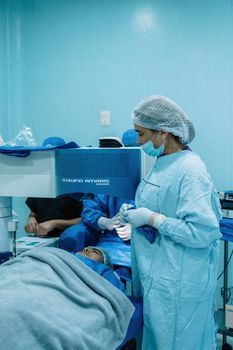
What happens on surgery day in Seoul?
The day itself is short; most of the time goes on checks. Many international patients have the exam and surgery on the same or consecutive days, so arrive having stopped contact lenses for the period your clinic specifies (see contact lens break before LASIK).
- Re-check: refraction, corneal thickness and topography are confirmed against your exam.
- Numbing drops: no injections or general anaesthetic are used.
- Flap: a femtosecond laser creates a thin corneal flap in under a minute per eye.
- Reshaping: the excimer laser applies the wavefront-optimised profile, usually in well under a minute per eye, with eye-tracking compensating for small movements.
- Rest and review: a short rest, a slit-lamp check, then you go back to your hotel with drops and shields.
Bring sunglasses and avoid scheduling anything for the rest of the day. A next-morning check is standard.
What should I ask the clinic about the laser profile?
Because 'wavefront' is used loosely in marketing, ask specific questions. Is the plan wavefront-optimised, wavefront-guided or topography-guided? Which excimer and femtosecond lasers will be used? Is the wavefront option included in the both-eye price, or an upgrade? What is the policy and cost for an enhancement if you are under-corrected after you fly home? A good clinic will show you your scans and explain why a particular profile suits your eyes. Our list of questions to ask your LASIK surgeon covers the rest.
Who is a good candidate?
Good candidates are adults with a stable prescription, healthy corneas of adequate thickness and no active eye disease. The pre-op exam in Seoul measures corneal thickness, topography, pupil size and tear film; these numbers decide whether LASIK, a surface procedure or a lens option is safer.
- Prescription stable for at least a year
- Corneal thickness and shape within safe limits (see corneal thickness for LASIK)
- No keratoconus, uncontrolled dry eye or pregnancy
- Realistic expectations about night vision and reading glasses after 40
If your aberrometry shows unusual higher-order aberrations, your surgeon may prefer a wavefront-guided or topography-guided plan. If your cornea is thin or irregular, they may advise against a flap altogether. Our LASIK candidacy guide walks through the exam.
What is recovery like?
Recovery is the same as for any LASIK. Most people see clearly within one to two days and return to desk work after a day or two.
| Time | What to expect |
|---|---|
| Day 0–1 | Watery, scratchy eyes; first check-up next morning |
| Days 2–7 | Vision sharpening; drops several times a day; no swimming or eye rubbing |
| Weeks 1–4 | Light halos at night are common and usually fade |
| Months 1–6 | Dryness gradually settles; final result stabilises |
Day-by-day detail is in our LASIK recovery guide. Most travellers fly home after 3–5 days once the surgeon is happy with the flap.
What are the risks?
A wavefront-optimised profile reduces, but does not remove, LASIK risks. Dry eye, glare, halos, under- or over-correction and rare flap problems are possible, and some people need an enhancement. Corneal ectasia is rare but serious, which is why careful screening matters more than the laser profile. See LASIK side effects for frequencies. This page is general information: get a full exam and an ophthalmologist's advice before deciding.
Sources
Key facts
- What it is: LASIK with an aspheric ablation that adds energy at the periphery to preserve corneal shape
- Seoul price: ₩1.5M–₩2.5M for both eyes (approx. $1,100–$1,900)
- Wavefront add-on: One Seoul clinic listed ₩300,000 as an option (Oct 2026)
- Common platform: Alcon WaveLight EX500 excimer laser
- Recovery: Most people see well within 1–2 days; dryness can last months
- Base procedure: LASIK surgery in Korea guide
Related guides
Independent directory. Prices are typical ranges reported by Seoul clinics and change often. Always confirm a written quote and get a full eye exam before booking. This page is general information, not medical advice.
FAQ
Frequently asked questions
Is wavefront-optimised LASIK better than regular LASIK?
It is designed to induce less spherical aberration than older conventional LASIK, which can mean fewer night-vision complaints. Most modern Seoul LASIK already uses an optimised or customised profile.
Is wavefront-guided better than wavefront-optimised?
For typical eyes, studies show similar results, with small advantages for wavefront-guided in some measures. Guided treatment may help eyes with significant pre-existing aberrations.
How much extra does wavefront cost in Korea?
Some clinics include it; one Seoul listing in October 2026 priced a wavefront option at ₩300,000. Always ask whether the quote is for both eyes and what it includes.
Can wavefront LASIK fix halos from previous surgery?
Sometimes a customised re-treatment helps, but it depends on corneal thickness and the cause. A surgeon must review your scans first.
How long should I stay in Seoul?
Plan 3–5 days: exam, surgery, and at least one follow-up before flying.
Planning vision correction in Seoul?
Compare clinics by district, check 2026 price ranges, and read our step-by-step planning guide for international patients.